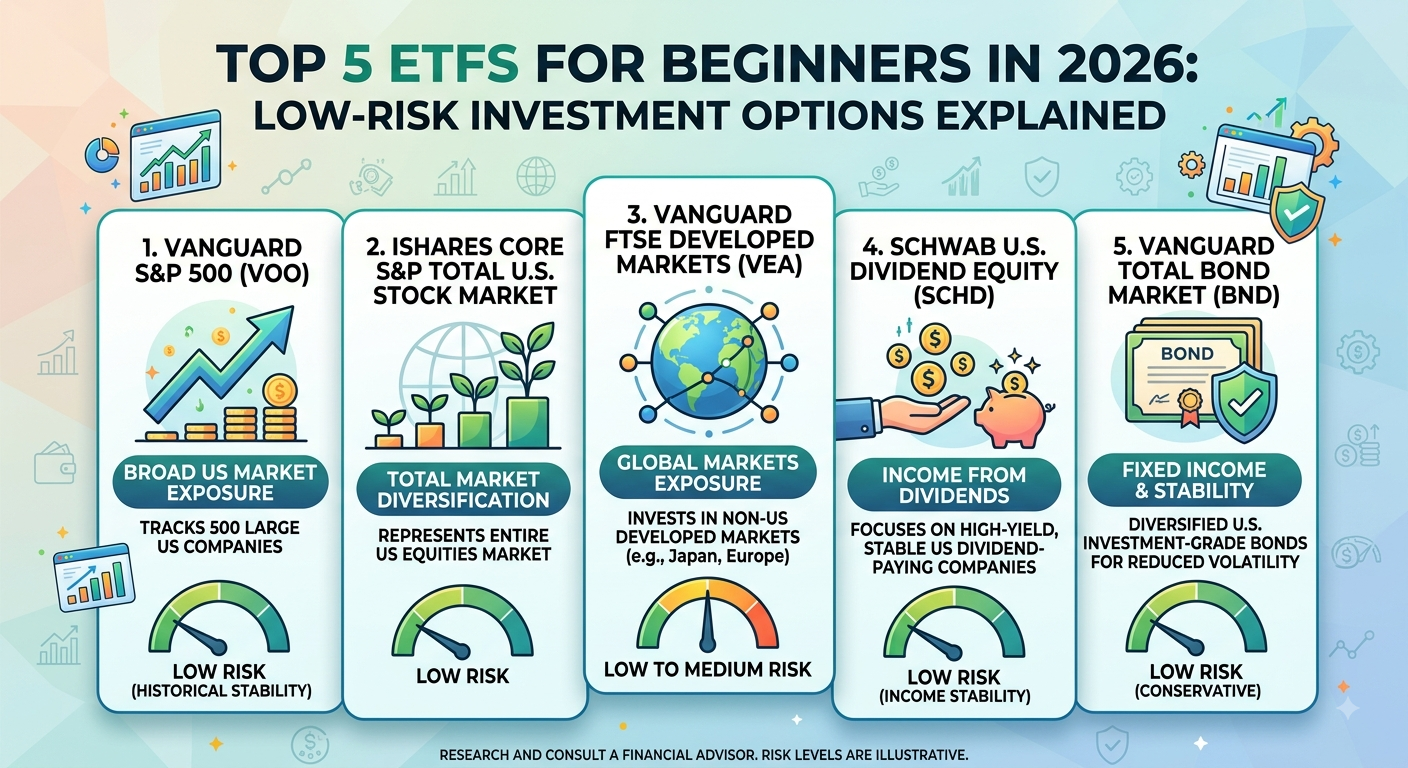
Top 5 ETFs for Beginners in 2026: Low-Risk Investment Options Explained
Top 5 ETFs for Beginners in 2026: Low-Risk Investment Options Explained
Exchange-traded funds (ETFs) are popular with beginner investors because they can provide exposure to many investments through a single fund. Instead of buying shares of dozens or hundreds of companies individually, an investor can buy one ETF that holds a diversified portfolio.
However, it is important to clarify one point: ETFs are not automatically low-risk investments. An ETF can fall substantially depending on what it owns. The risk of a broad stock-market ETF is different from the risk of a bond ETF, sector ETF, or leveraged ETF. The U.S. Securities and Exchange Commission (SEC) notes that ETFs can lose some or all of the money invested, and that different funds have different levels of risk and reward.
For beginners, the most useful question is therefore not simply "Which ETF is safest?" but "Which ETF matches my investment goal, time horizon, and ability to tolerate losses?"
This guide examines five widely used ETFs that beginners may want to research in 2026. They cover broad U.S. stocks, the global stock market, dividend-paying companies, and bonds.
What Is an ETF?
An exchange-traded fund is an investment fund that pools money from investors and uses it to buy a portfolio of stocks, bonds, or other assets. ETF shares trade on stock exchanges during market hours, similar to individual stocks.
Many ETFs are designed to track an index. Instead of trying to select individual winning companies, an index ETF attempts to follow the performance of a particular market or group of securities.
This structure can make diversification easier. However, diversification does not eliminate investment risk. An ETF focused on one industry, country, or security type can still be highly volatile.
How ETFs Make Money
Investors can potentially earn money from ETFs in several ways.
Capital Appreciation
If the securities held by an ETF increase in value, the ETF's market price can also rise. An investor who sells at a higher price than the purchase price may realize a capital gain.
Dividends and Interest
An ETF can receive dividends from stocks or interest from bonds held in its portfolio. The fund may distribute some of this income to shareholders.
Reinvestment
Investors can sometimes reinvest distributions to purchase additional shares, potentially allowing their investment to compound over a long period.
The SEC identifies increased market price, dividend or interest payments, and capital-gain distributions as potential sources of ETF returns.
Top 5 ETFs for Beginners in 2026
1. Vanguard Total Stock Market ETF (VTI)
VTI is designed to provide broad exposure to the U.S. stock market. Instead of relying on one company or one industry, it invests across a wide range of U.S. companies.
This broad exposure makes VTI an option worth researching for beginners who want a simple way to participate in the U.S. equity market.
However, VTI is still a stock ETF. Its value can decline significantly during a market downturn, so it should not be considered a low-risk asset in the same way as cash or short-term government securities.
Best suited for: Long-term investors seeking broad U.S. stock-market exposure.
Main advantage: Broad diversification across U.S. companies.
Main risk: It can fall substantially during stock-market declines.
2. Vanguard S&P 500 ETF (VOO)
VOO tracks the S&P 500, an index representing large U.S. companies.
It provides exposure to major businesses across sectors such as technology, healthcare, financial services, consumer goods, and industrials.
For beginners who want to invest in a broad group of established U.S. companies rather than selecting individual stocks, an S&P 500 ETF can be a straightforward starting point.
However, VOO is not the same as owning the entire U.S. stock market. It focuses on large-cap companies represented in the S&P 500.
Best suited for: Beginners seeking long-term exposure to large U.S. companies.
Main advantage: Simple exposure to a large group of major U.S. companies.
Main risk: It remains exposed to stock-market volatility.
3. Vanguard Total World Stock ETF (VT)
VT provides exposure to stocks from markets around the world, rather than concentrating solely on the United States.
This can be useful for investors who want broader geographic diversification.
International diversification can reduce dependence on the performance of a single country's stock market, although it introduces additional considerations such as currency movements, geopolitical developments, and differences between international markets.
Best suited for: Long-term investors who want global stock exposure through one ETF.
Main advantage: Broad geographic diversification.
Main risk: Global stock markets can decline, and international investments can involve currency and geopolitical risks.
4. Schwab U.S. Dividend Equity ETF (SCHD)
SCHD focuses on U.S. companies that meet specific dividend-related and quality criteria.
Dividend-focused ETFs can appeal to investors who are interested in companies that distribute part of their earnings to shareholders.
However, investors should not assume that a dividend ETF is automatically safer than a broad-market ETF. Dividend-paying companies can still lose significant value, and dividends can be reduced or suspended.
Best suited for: Investors interested in dividend-oriented U.S. equities.
Main advantage: Provides exposure to a portfolio of dividend-focused U.S. companies.
Main risk: It remains an equity investment and can decline when the stock market falls.
5. Vanguard Total Bond Market ETF (BND)
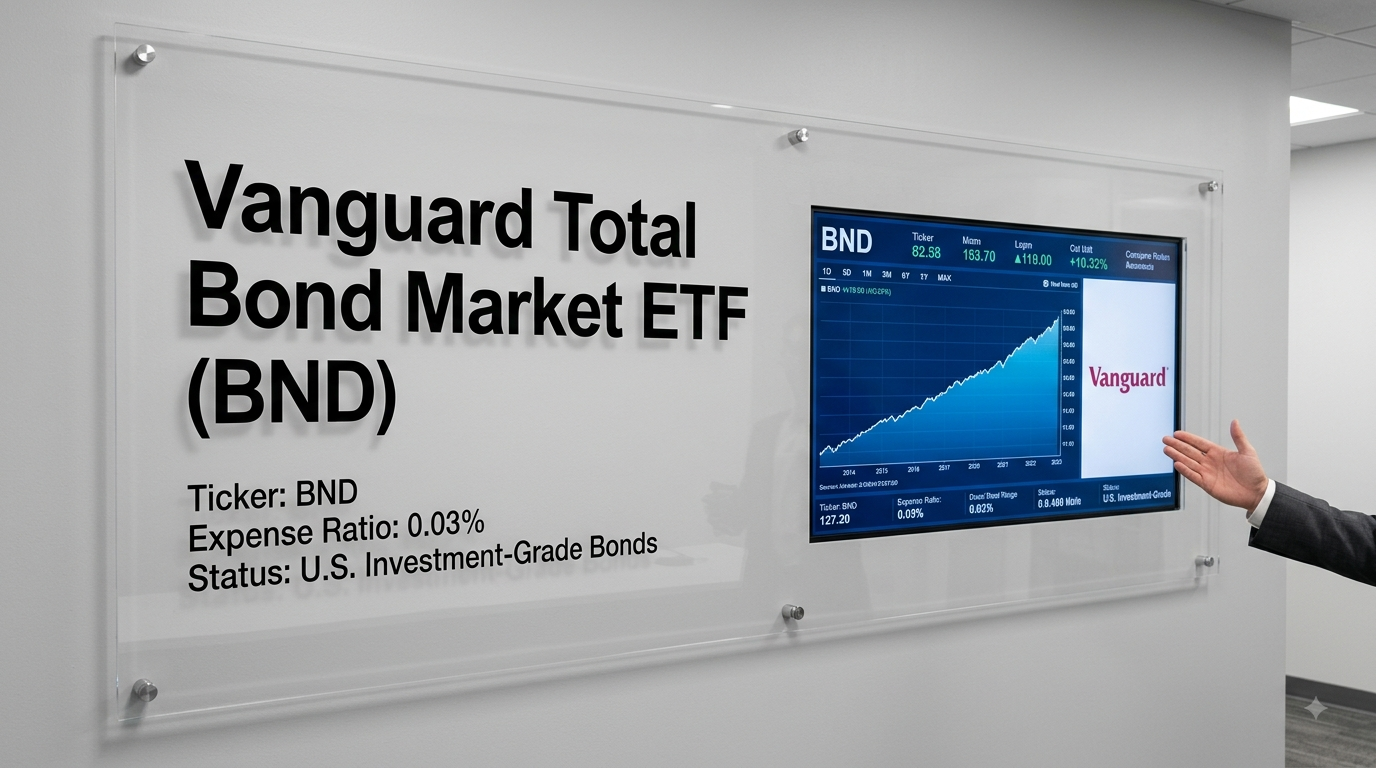
BND is different from the four stock-focused ETFs above because it invests primarily in U.S. bonds.
Bond ETFs can play a role in reducing the stock exposure of a portfolio and may be more appropriate for investors who want a combination of growth and income assets.
However, bond ETFs are not risk-free. Bond prices can fall when interest rates rise, and the fund's value can fluctuate.
Best suited for: Investors seeking exposure to a broad portfolio of U.S. bonds.
Main advantage: Provides diversification away from stocks.
Main risk: Interest-rate changes, credit risk, and market movements can affect its value.
Quick Comparison of the 5 ETFs
- VTI: Broad U.S. stock-market exposure.
- VOO: Large U.S. companies through the S&P 500.
- VT: Global stock-market exposure.
- SCHD: Dividend-focused U.S. stocks.
- BND: Broad U.S. bond-market exposure.
The right choice depends on what you want your portfolio to accomplish. These funds should not be viewed as five investments that every beginner must own.
Pros and Cons
Pros of ETFs
- Diversification: One ETF can provide exposure to many securities.
- Accessibility: ETFs can generally be bought and sold through brokerage accounts.
- Transparency: Many ETFs disclose their holdings regularly.
- Potentially low costs: Many broad index ETFs have relatively low expense ratios.
- Flexibility: ETF shares trade during market hours like stocks.
The SEC notes that ETFs can offer diversification, liquidity, and relatively low minimum investment requirements, although costs and risks differ between funds.
Cons of ETFs
- Market losses: ETFs can lose value.
- Fees: Every fund has operating expenses that affect returns.
- Trading costs: Brokerage charges and bid-ask spreads can add costs.
- Concentration: Some ETFs are less diversified than they appear.
- Currency risk: Nigerian investors buying foreign ETFs face exchange-rate movements.
Who Should Invest in These ETFs?
These ETFs may be worth researching if you are a beginner who:
- Has a long-term investment horizon.
- Understands that investments can lose money.
- Wants diversification rather than relying on a single company.
- Can tolerate fluctuations in portfolio value.
- Has an emergency fund and does not need the invested money immediately.
Someone saving for a short-term expense may not be suitable for a portfolio heavily invested in stock ETFs. The SEC's investor guidance emphasizes that asset allocation should reflect your financial goals, time horizon, and risk tolerance.
How to Invest in ETFs from Nigeria
Nigerian investors who want exposure to U.S.-listed ETFs need a brokerage or investment platform that legally provides access to those securities to Nigerian residents.
Step 1: Choose a Suitable Broker
Research the platform's regulatory status, fees, custody arrangements, available ETFs, withdrawal rules, and currency-conversion costs.
Step 2: Complete Verification
International brokers normally require identity and tax information before allowing an account to trade.
Step 3: Fund the Account
Funding methods vary. Nigerian investors should pay attention to the total cost of converting naira into U.S. dollars and transferring funds.
Step 4: Select the ETF
Read the ETF's prospectus and fund information before buying. Look at its investment objective, holdings, expense ratio, risks, historical performance, and distribution policy.
The SEC specifically recommends reviewing an ETF's prospectus and understanding its objectives, strategies, risks, and costs before investing.
Step 5: Invest for the Appropriate Time Horizon
Do not choose an ETF simply because it performed well recently. Past performance does not guarantee future results.
Risks Nigerian Investors Should Understand
Market Risk
A stock ETF can decline when the companies or markets it tracks decline. Even a highly diversified ETF can experience substantial losses during a major market downturn.
Currency Risk
If you invest from Nigeria in a U.S.-dollar ETF, your return in naira can differ from the ETF's return in dollars because of changes in the naira-dollar exchange rate.
Interest-Rate Risk
This is particularly relevant to bond ETFs such as BND. Rising interest rates can reduce the market value of existing bonds.
Concentration Risk
An ETF may contain many securities but still have significant exposure to particular companies, sectors, or countries. Always examine what the fund actually owns.
Inflation Risk
Your investment return should be considered alongside inflation. An investment can increase in nominal value while providing a weaker increase in real purchasing power.
Platform and Regulatory Risk
Nigerian investors should verify the investment platform they use and understand how their assets are held. Access to a legitimate ETF does not mean every platform offering that ETF is legitimate.
Common Mistakes Beginners Should Avoid
1. Thinking Every ETF Is Safe
The word "ETF" describes a structure, not a risk level. A broad-market ETF, bond ETF, leveraged ETF, and single-stock ETF can have very different risk profiles.
The SEC specifically warns that some ETFs are less diversified and that leveraged or single-stock ETFs can carry substantially greater risk.
2. Buying Based Only on Past Returns
A fund that performed exceptionally well in the past may not repeat that performance.
3. Ignoring Fees
Expense ratios, brokerage charges, bid-ask spreads, currency-conversion costs, and other expenses can reduce your overall return. Even relatively small differences in fund expenses can matter over long periods.
4. Investing Money Needed Soon
Stock ETFs can experience major short-term declines. Avoid investing money that you will need for essential expenses in the near future.
5. Buying Too Many Similar ETFs
Owning five ETFs does not necessarily mean you are well diversified. Several ETFs may contain many of the same companies.
FAQ Section
1. What is the safest ETF for beginners?
There is no universally safest ETF. Risk depends on the assets held by the fund and the investor's circumstances. Bond ETFs can generally have a different risk profile from stock ETFs, but they are not risk-free.
2. Are VOO and VTI the same?
No. VOO tracks the S&P 500 and focuses on large U.S. companies, while VTI provides broader exposure to the U.S. stock market. They also have substantial overlap in their holdings.
3. Is an ETF better than buying individual stocks?
Not necessarily, but an ETF can make diversification easier. Instead of depending on the performance of one company, a diversified ETF can spread exposure across many securities.
4. Can Nigerians buy U.S. ETFs?
Nigerian residents may be able to access U.S.-listed ETFs through investment platforms that legally offer international securities to Nigerian clients. Availability, funding methods, fees, and regulatory arrangements vary between providers.
5. Can I lose money in an ETF?
Yes. ETFs are investments, not guaranteed savings products. If the securities held by an ETF decline in value, the ETF's value can also decline. Investors can lose some or all of their invested money.
Conclusion
ETFs can be useful building blocks for a beginner's investment portfolio because they can provide diversification through a single investment. But ETF does not mean risk-free.
For beginners researching options in 2026, VTI, VOO, VT, SCHD, and BND represent different approaches to investing: broad U.S. stocks, large-cap U.S. stocks, global equities, dividend-focused stocks, and bonds.
The best ETF depends on your investment goal, time horizon, risk tolerance, diversification needs, fees, and tax situation. Nigerian investors should also consider currency risk and the reliability of the platform through which they invest.
Rather than choosing an ETF because it is popular, study what it owns, understand how it makes money, check its costs, read its prospectus, and make sure it fits your overall financial plan. No ETF can guarantee a profit, and no investment should be described as completely risk-free.
Important: This article is for educational purposes and is not personalized financial advice. Investment decisions should be based on your individual financial circumstances and risk tolerance.